
STUDY: TRUMP ADMINISTRATION TARIFFS RAISED COSTS ON MIDWEST HOUSEHOLDS BY AN AVERAGE OF $2,000 IN 2025
ILLINOIS, USA / AGILITYPR.NEWS / July 22, 2026 / Data shows import taxes hit Midwest harder than nation, raising costs, shrinking the economy, reducing manufacturing employment, and disproportionately impacting low-income families
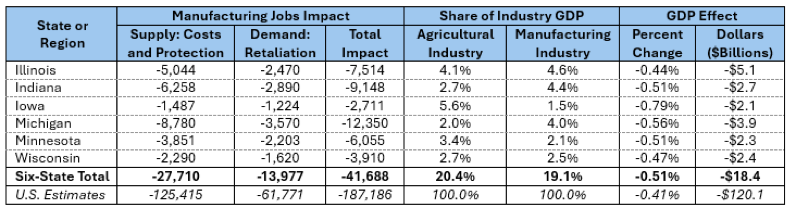
La Grange, IL: Tariffs imposed by the Trump Administration in 2025 raised costs for the average Midwest household by more than $2,000, shrunk the economy by $18 billion, reduced the region’s manufacturing employment by more than 41,000, and disproportionately impacted low-income households, according to a new study by the nonpartisan Midwest Economic Policy Institute (MEPI) and the Project for Middle Class Renewal (PMCR) at the University of Illinois at Urbana-Champaign.
In 2025, the Trump administration increased tariffs on imported goods and supply chains to their highest levels since the 1930s, causing some nations to respond with retaliatory measures against U.S. exports. While many of the Trump administration’s 2025 levies were ruled unconstitutional by the U.S. Supreme Court in February 2026, they were replaced with a temporary 10% global tariff that expires this week. The administration has already begun announcing new tariff rates, including a new 50% levy on most Canadian goods.
The report uses data from the U.S. Department of Labor, U.S. Department of Commerce, U.S. Census Bureau, U.S. Department of Agriculture, and Pew Charitable Trusts alongside tariff impact modeling from the Budget Lab at Yale University to quantify the effects on six Midwest States: Illinois, Indiana, Iowa, Michigan, Minnesota, and Wisconsin. Household costs are based on each state’s consumer spending, market for imports, and manufacturing industry composition, while economic impacts are scaled by each state’s trade exposure and trend-adjusted manufacturing job losses capture both direct layoffs and jobs that would have existed without the tariffs.
“Research consistently shows the costs of tariffs are passed along to consumers, and the Midwest has faced outsized exposure because consumer spending accounts for more than two-thirds of all economic activity and the region is responsible for about one-fifth of the nation’s manufacturing and agricultural output,” said ILEPI Economist and study coauthor Frank Manzo IV. “The data confirms that the trade war launched in 2025 has been a substantial headwind for the economy, with Midwest households faring far worse than the nation as a whole.”
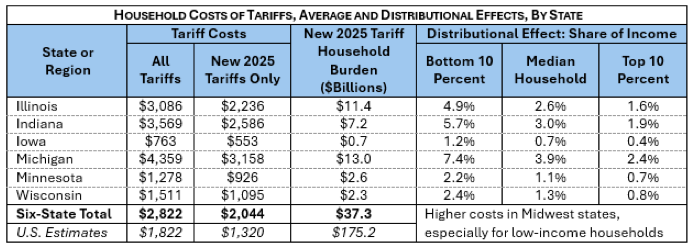
The analysis found the 2025 tariffs added more than $2,000 in costs on average to each of the Midwest’s 18 million households. They cost as much as $3,200 in Michigan, which boasts the region’s highest share of consumer spending as a percentage of GDP. Overall, tariff-linked household cost increases in the Midwest were 55% higher than the national average ($1,320).
ILEPI and PMCR researchers noted that these cost increases disproportionately burdened low-income families, estimating they paid 3 times more of their incomes on higher-priced goods subject to tariffs than wealthier households.
“By raising the price of many consumer goods, tariffs impact low-income families who can least afford price hikes,” added University of Illinois Professor and PMCR Director Dr. Robert Bruno. “In 2025, the people most impacted by higher costs were still reeling from pandemic era supply-chain disruptions and inflationary spikes that surpassed their wage growth.”
In addition to higher consumer prices, the data reveals that after years of expansion, both U.S. manufacturing employment and agricultural exports contracted in 2025. Driven by tariff-induced increases to production costs and foreign retaliation against U.S. exports, researchers estimate that this cost the Midwest nearly 42,000 manufacturing jobs and trimmed more than $18 billion from the region’s GDP. While all states suffered losses, Michigan and Indiana suffered the biggest hit to manufacturing employment, Iowa suffered the greatest vulnerability on agricultural exports, and the diversified Illinois economy saw the largest decline in GDP.
“While a targeted tariff policy has long been used as a tool for protecting U.S. producers from unfair competition and strengthening domestic supply chains, the blanket policy enacted by the Trump administration made no such distinctions,” Manzo added. “The data shows that this caused disproportionate economic harm in the Midwest due to the importance of manufacturing and agriculture to the region’s economy.”
Looking ahead, researchers cautioned that any blanket tariff regime would increase household costs, reduce factory jobs, and produce weaker GDP growth than the alternative with no such levies in place.
In light of the Supreme Court’s action to invalidate most of the 2025 tariffs, researchers urged policymakers to consider a range of actions to mitigate their impacts—including repealing blanket tariffs against nations with similar standards as the United States, issuing refund checks directly to taxpayers adversely affected by unconstitutional tariffs, and clawing back taxpayer subsidies to businesses that offshore jobs.
“Consumers ultimately pay the cost of tariffs, with working families bearing a disproportionate burden,” concluded Bruno. “Targeted tariffs can be effective at prioritizing American workers and industries, but one-size-fits-all ‘blanket’ policies can disrupt supply chains, increase production costs, and invite retaliation that results in higher prices, fewer jobs, and less access to global markets. No region of the country is more exposed to these risks than the Midwest.”

The Midwest Economic Policy Institute (MEPI) is a nonprofit, nonpartisan research organization founded in 2013 to deliver actionable research and expert analysis on public policy issues impacting businesses, working families, and taxpayers.

The Project for Middle Class Renewal (PMCR) at the University of Illinois at Urbana-Champaign investigates working conditions in today's economy to elevate public discourse aimed at reducing poverty, creating more stable forms of employment, and promoting middle-class jobs.
Contacts
Todd Stenhouse
toddstenhouse@gmail.com